I saw a post this week that stopped me mid-scroll:
“The idea of a ‘Pilates body’ isn’t real. It’s a marketing tool designed to make people think they need to change themselves to belong.”
She’s right. And it’s exactly why we do things differently at HPY.
Open Instagram and search for Pilates. What do you see? Long, lean bodies in matching activewear. Hyper-flexible people folding themselves into impossible shapes. Perfectly lit studios with perfectly toned instructors.
The message is clear: this is what you should look like if you do Pilates.
And it’s complete rubbish.
Pilates doesn’t give you a certain type of body. It helps you build strength, mobility, and control in the body you already have. Joseph Pilates worked with injured soldiers, elderly clients, and everyday people who just wanted to move better. His method was never about achieving an aesthetic.
But function doesn’t get likes. Perfect bodies in perfect poses do.
Most studio owners don’t sit down thinking “how can I make people feel inadequate today?”
They start with good intentions. They post a mix of content: educational stuff, behind-the-scenes moments, real members doing real work.
But then they notice something. The post of sexy Sarah doing a beautiful teaser in matching activewear gets 400 likes. The post explaining how to protect your lower back gets 40.
So next week, they post more Sarah. Less education.
The algorithm rewards what gets attention. What gets attention is aspirational aesthetics. So studios post more of that, which trains the algorithm to show more of that, which means only that content performs.
It’s survival of the thinnest.
Eventually, every Pilates account looks the same: lean, bendy, beautiful people making it look effortless. Meanwhile, the 58-year-old wondering if Pilates might help her back pain scrolls past and thinks, “that’s not for people like me.”
The studios didn’t mean to exclude her. But the algorithm did it for them.
Before you throw out your vegetables, there’s important context here.
Diet quality did show a benefit for cancer risk specifically – a 14% reduction for those eating well. So food absolutely matters for certain outcomes.
And the study was clear: neither factor compensates for the other. You can’t out-exercise a terrible diet, and you can’t out-diet complete inactivity. They work independently.
But if you’re someone who’s been meticulous about what you eat while telling yourself you’ll “start exercising when things calm down” – this research suggests you might have the priorities backwards.
Movement isn’t the cherry on top. It’s the foundation.
You won’t see carefully curated shots of our most flexible members on our feed. You won’t see before-and-after weight loss transformations. You won’t see us promising you’ll “lengthen and tone” your way to a different body.
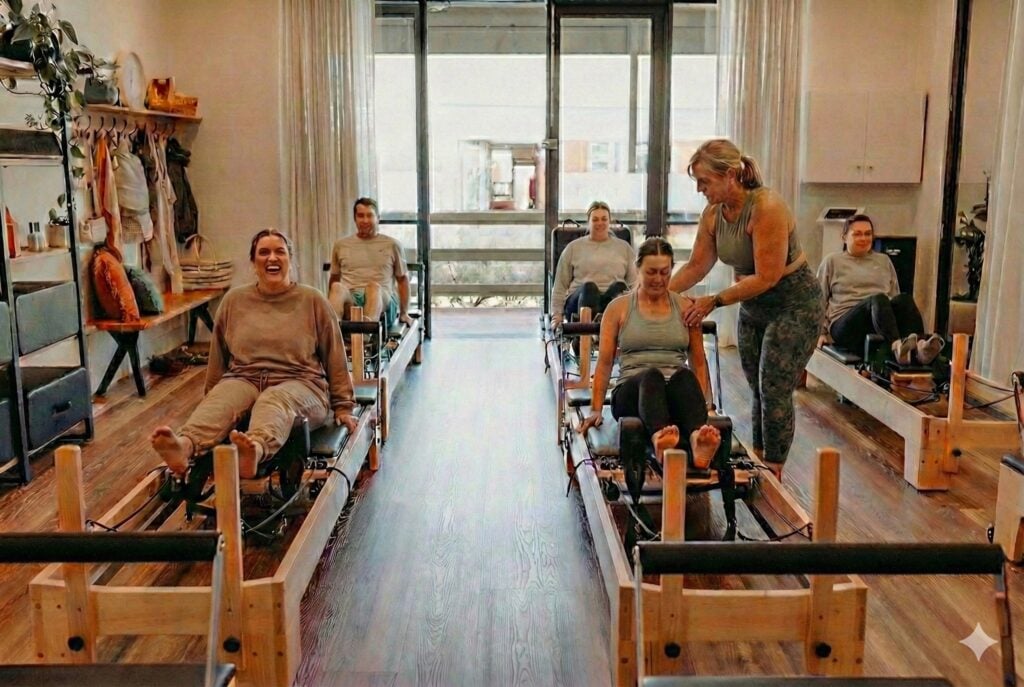
Our members look like regular people. Because they are regular people. Women in their 50s keeping up with grandkids. Desk workers with aching backs. People recovering from injuries or just years of not moving enough. Flexible and not-so-flexible. Every body in between.
What they have in common: they’re all getting stronger.
Helen came to us with a bone density score of -2.2. Osteoporosis. After consistent practice, her score improved to -1.6. That’s not a “Pilates body” transformation. That’s a woman rebuilding her skeleton from the inside out.
You won’t see that in a filtered Instagram post.
Our model is built around keeping members, not constantly finding new ones. So we’d rather spend our energy on the people already in the room than chasing vanity likes with perfect, sexy bodies.
Pardon our stop-and-go posting. When we do show up, it’s because we’ve got something worth saying.
Your body is already a Pilates body the second you decide to move it.