There’s a reason you handle stress better since you started coming here. And it has nothing to do with your core.
I left a book I was reading on our kitchen bench a couple of months ago. Ryan Holiday’s Stillness Is the Key. Forgot about it.
Mel picked it up at 2am one night. Couldn’t sleep. Read half of it. The next morning she said: “This is what I’m teaching. This is why Pilates works. I just didn’t have the words for it.”
She was right. And that moment changed how we think about everything we do at HPY.
I should introduce myself. I’m Reid, Mel’s husband. I do the planning, the tech, the marketing, the light bulbs, the speakers, and the occasional mid-class coffee delivery. Mel’s been flat out this week (three studios and Free February will do that), so you’re stuck with me.
And I’ll take the opportunity to write about something Mel probably wouldn’t… That the ideas behind that book, ancient Stoic philosophy, map almost perfectly onto what happens in a Pilates or yoga class.
Control what you can. Work with obstacles. Respond instead of react. Show up consistently.
I’d been reading the stoics for years and Mel had been teaching their principles without knowing it.
But I want to talk about two ideas in particular.
The ones that changed how we think about everything. Not just exercise.
The Stoics believed that if you practise being uncomfortable by choice, you stop being overwhelmed when life makes you uncomfortable without asking. Not punishment. Training.
You’re already doing this. Every time the instructor says “hold here” and everything burns and your mind is negotiating for an early exit, that’s voluntary discomfort. You chose to be there. You could stop. But you stay, breathe, hold form. Your nervous system learns that discomfort isn’t an emergency.
I try to do the same thing with ice baths (seasonally and inconsistent, if I’m honest). Same principle, just colder and with less instruction. The reformer is honestly a better training ground. You’ve got someone guiding you through it.
It’s paradoxical that movement can bring us stillness. But it does.
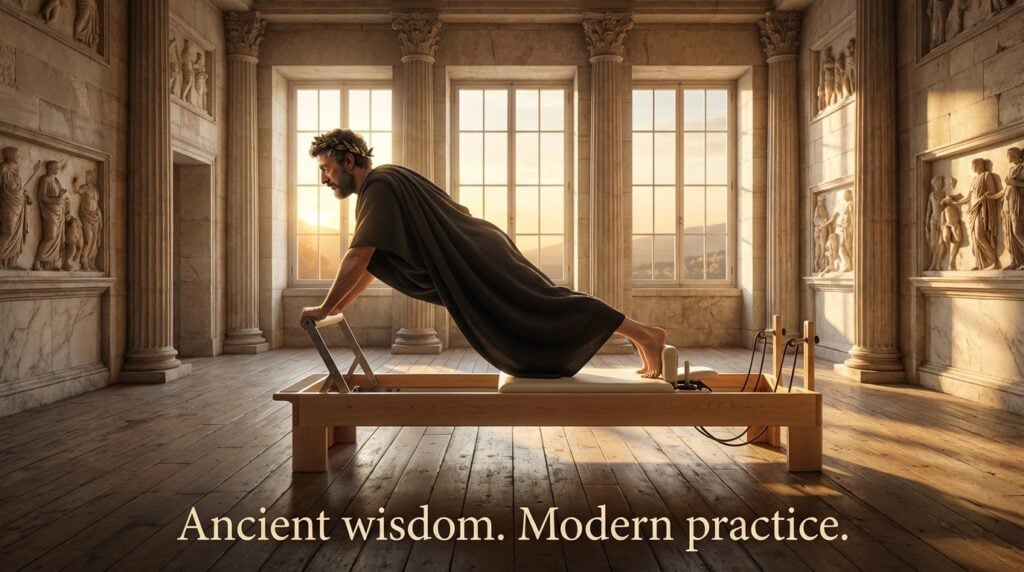
You can’t hold a plank on a reformer and think about your to-do list. You can’t hold warrior three and replay an argument from yesterday. The movement, the breath, the control. It requires everything you’ve got. There’s no bandwidth left for your brain’s background anxiety programme.
People say they feel calmer after class. They think it’s the exercise. It’s partly that. But it’s mostly that for an hour, their mind was fully occupied with something real. And the stillness that creates doesn’t evaporate when you walk out the door.
You won’t notice this as some dramatic life shift. It’s smaller and more honest than that.
It’s not snapping at the kids before school when you’re running late and someone’s lost a shoe. It’s getting through a week where money is tight without it sitting in your chest the whole time. It’s being in the middle of a difficult conversation and realising you’re actually holding it together.
Your nervous system doesn’t know the difference between holding plank on a reformer (or a pose on a yoga mat) and handling any of that. It just knows: this is hard, and we’re staying calm anyway.
Three times a week for a few months and you’ve trained a pattern. Discomfort is not an emergency. We can stay present. We can respond instead of react.
That’s not Pilates magic. That’s just what happens when you practise staying calm under pressure in a controlled environment. The reformer, the mat, the yoga studio. They’re all training grounds for the stuff that actually matters.
You don’t need Stoic philosophy. You don’t need ice baths.
You just need to move. With attention. Consistently.
That’s what this place is built on. Not the equipment, not the branding and certainly not our Instagram feed. The principle that showing up regularly and paying attention to what you’re doing creates benefits that go well beyond your body.
Mel teaches this better than I could ever explain it. She’s been doing it for years. She just didn’t have a philosophical framework attached to it until I started leaving books on the kitchen bench.
If any of this landed, try something after your next class. When you walk out, check in with yourself. Not the “how many calories did I burn” check-in. An honest one. Is your head quieter? Are your shoulders lower? Do you feel more like yourself than when you walked in?
If the answer is yes, that’s not a coincidence. That’s the training working.
Not just on your body.
On everything.
Thanks for showing up.