I came across a video the other day that made me stop scrolling. A doctor was talking about a massive study – one of the biggest ever done – looking at whether diet or exercise matters more for how long we live.
Not just “losing weight” long. Actually living longer.
I had to dig into it. And what I found genuinely surprised me.
Researchers followed 346,627 people for over 11 years. They tracked what they ate, how much they moved, and – well – who died.
Here’s what stood out:
For all-cause mortality (your overall risk of dying from anything), exercise showed a clear, measurable benefit. People who moved regularly had a 9-13% lower risk of death compared to those who didn’t.
Diet quality on its own? Not statistically significant.
Let me say that again: when it came to overall mortality risk, diet alone didn’t move the needle in a measurable way. Exercise did.
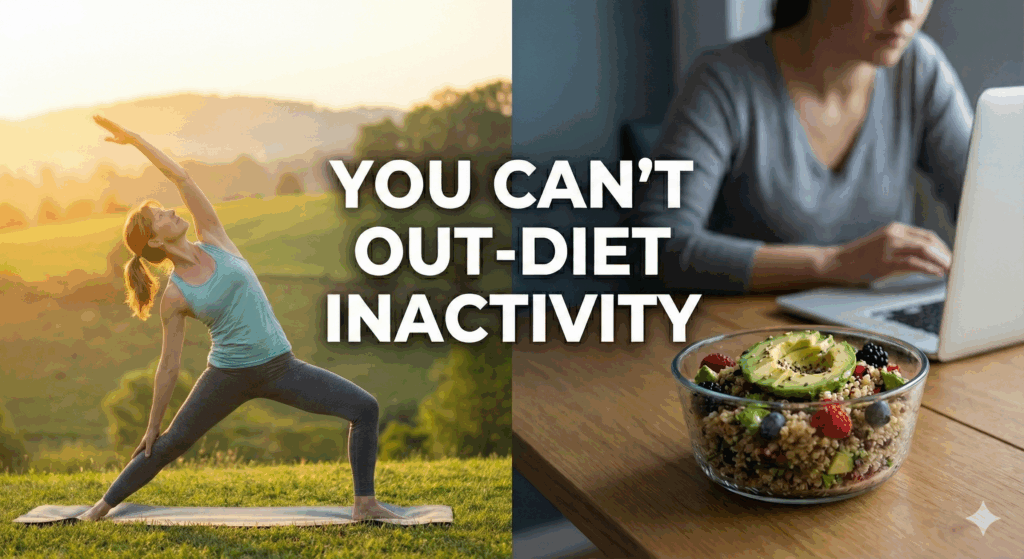
The researchers put it bluntly: you can’t offset the impacts of low physical activity with a high-quality diet.
You’ve probably heard that phrase. I certainly have. It’s become fitness gospel – the idea that what you eat matters far more than whether you move.
And look, for weight loss specifically, there’s some truth to it. You can’t outrun a bad diet if your goal is dropping kilos.
But this study wasn’t about weight. It was about living longer. And for that, the data flipped the script.
Exercise wasn’t 20% of the equation. For all-cause mortality, it was the factor that actually showed up with statistical significance.
That’s not permission to eat rubbish. But it might be permission to stop obsessing over your macros while skipping movement entirely.
Before you throw out your vegetables, there’s important context here.
Diet quality did show a benefit for cancer risk specifically – a 14% reduction for those eating well. So food absolutely matters for certain outcomes.
And the study was clear: neither factor compensates for the other. You can’t out-exercise a terrible diet, and you can’t out-diet complete inactivity. They work independently.
But if you’re someone who’s been meticulous about what you eat while telling yourself you’ll “start exercising when things calm down” – this research suggests you might have the priorities backwards.
Movement isn’t the cherry on top. It’s the foundation.
Here’s what I keep coming back to: the mortality benefit came from regular physical activity. Not extreme fitness. Not punishing workouts. Just consistent movement.
That’s good news if you’ve been avoiding exercise because it feels like too much.
You don’t need to crush yourself. You need to show up.
And showing up is a lot easier when the movement itself feels good. When it’s something you look forward to rather than dread. When it leaves you feeling better than when you walked in, not wrecked.
That’s exactly what Pilates and yoga offer. They’re not about suffering through something hard. They’re about building strength, flexibility, and control in a way that actually feels sustainable. The kind of movement you can do for decades – which, according to this research, is precisely the point.
If you’ve been putting all your energy into eating perfectly while movement takes a back seat, consider this your gentle nudge to flip that.
Both matter. But if you’re only going to prioritise one thing this week, make it moving your body.
It doesn’t have to be a lot. It doesn’t have to be intense. It just has to be consistent.
And if you’ve been meaning to get back to class – or try it for the first time – your body will thank you. Not just now, but for years to come.
See you in class,
Mel
Reference: Ding D, et al. “Physical activity, diet quality and all-cause cardiovascular disease and cancer mortality: a prospective study of 346,627 UK Biobank participants.” British Journal of Sports Medicine, 2022.

Unwind, Strengthen, Stand Tall, Embrace Life
Hurstbridge: 12/920 Heidelberg–Kinglake Rd, Hurstbridge VIC 3099
Diamond Creek: 75 Main Hurstbridge Rd. Diamond Creek VIC 3089
© 2024 Hurstbridge Pilates & Yoga