Joseph Pilates was interned as a German “enemy alien” in England during World War I. He ended up at an internment camp on the Isle of Man, working as an orderly in the camp hospital.
Picture it: bedridden patients, no proper rehabilitation equipment, and a man who believed passionately that movement was medicine.
So he improvised.
He attached springs from hospital beds to create resistance that patients could work against while lying down. Not resistance to fight against. Resistance to guide movement. Gentle, controlled motion for people too weak to stand up and exercise normally.
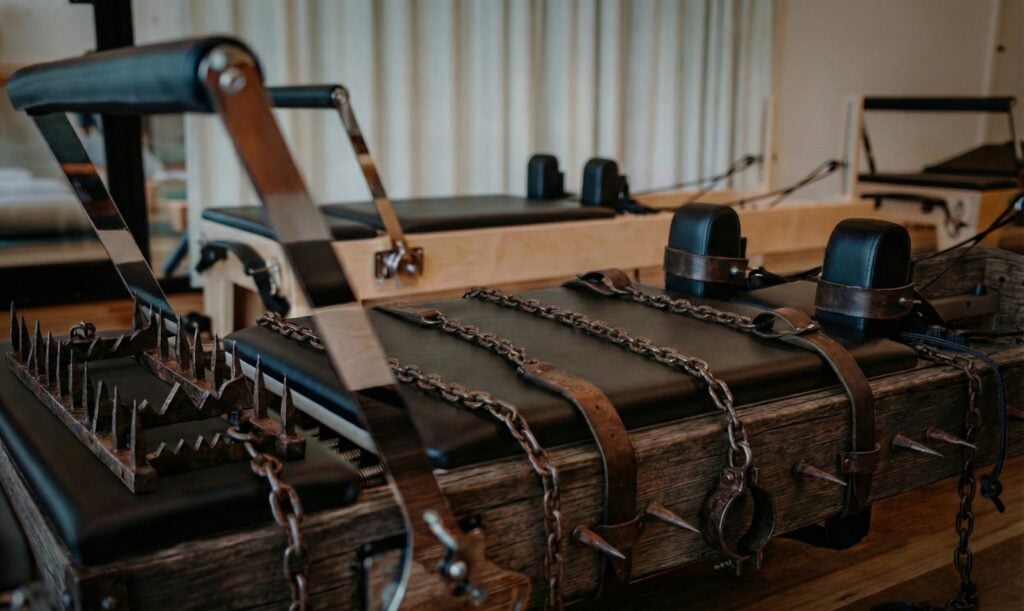
That’s where your “torture device” comes from. It wasn’t designed to punish bodies. It was designed to rehabilitate them. To help sick, injured, and bed-bound people get stronger without gravity working against them.
The apparatus Joseph Pilates originally called the “Universal Reformer” was literally a tool of healing. The springs weren’t there to hurt you. They were there to help your body relearn what it had forgotten.
The Pilates reformer does something no gym equipment can replicate: it provides variable resistance that teaches your body to control movement through the entire range.
Here’s the counterintuitive part. Sometimes less spring tension is actually harder. Because with less resistance, there’s nothing helping you control the carriage. Your muscles have to do all the stabilising work themselves.
The springs are teachers, not tormentors. They give your body constant feedback. If you’re rushing, you’ll feel it. If you’re out of alignment, you’ll know. Your brain has to stay engaged in a way that never happens on a leg press or cable machine.
This is what researchers now call proprioception: the awareness of where your body is in space. Pilates on the reformer trains this constantly. Every spring adjustment, every movement of that carriage, is information flowing between your muscles and your brain.
Recent studies have found that this kind of mindful movement doesn’t just strengthen muscles. It actually changes how your brain maps your body. The attention required keeps your mind engaged in ways that a typical gym workout simply doesn’t.
Joseph Pilates had a name for his method before the world called it Pilates: he called it Contrology. The mind controlling the body. That’s exactly what reformer Pilates trains.
I want to be honest about something.
Reformer Pilates injuries are rising. But the problem isn’t the apparatus. The problem is what’s happened to instruction.
Joseph Pilates never taught a group reformer class. Not once. In his original studio, apparatus work was always one-on-one. A teacher watching, correcting, adjusting with their hands. Group classes were for mat work only.
When safety experts studied reformer injuries, they found a pattern. It wasn’t that the equipment was dangerous. It was that instructors weren’t properly trained to teach it. Weekend online courses. No education on how to actually supervise a room. No training in hands-on correction. No understanding of how to guide someone into the right position rather than just calling out the next exercise.
Reformer Pilates requires a specific kind of teaching. You can’t just demonstrate from the front and hope everyone figures it out. You need to walk the room. Watch bodies. Physically adjust alignment when someone’s out of position. Know what to look for before a problem becomes an injury.
That’s a skill. And too many instructors were never taught it.
When you’re looking for a place to learn reformer Pilates (whether that’s with us or anywhere else), here’s what you should expect:
Instructors trained specifically in how to supervise, guide, and correct. Not just in the exercises themselves, but in how to actually teach them. Walking the room. Watching bodies. Physically adjusting alignment when needed.
Hands-on correction as standard practice. Joseph Pilates was famous for physically guiding his students’ bodies into the right positions. That’s because precise movement matters. A slight misalignment, repeated hundreds of times, becomes a problem. A small adjustment in the moment prevents it entirely.
Someone who checks your spring settings and explains why they matter. Who teaches you how the equipment works, not just which exercises to do on it.
And here’s one you might not think about: no mirrors. Mirrors encourage you to watch yourself and self-correct based on what you see. But Pilates isn’t about how movement looks. It’s about how it feels. An instructor watching you will catch things a mirror never could. That’s why we don’t have them.
ere’s what I wish every person nervous about trying reformer Pilates would hear:
The question isn’t “is the reformer safe?” It is, when taught properly. The apparatus was designed to rehabilitate injured people.
The question isn’t “will I look stupid?” Everyone looks uncertain their first time. The instructors remember being beginners too.
The real questions are: “Will someone actually watch me and correct me? Does the instructor know how to guide me into the right position, or just call out exercises from the front?”
Those are the questions that determine whether you’ll build strength and confidence or end up frustrated and possibly hurt.
f you’ve been curious about reformer Pilates but intimidated by the look of it, I hope this helps.
That apparatus was invented by a man trying to help sick people move again. The springs exist to teach your body, not test it. The whole contraption, as strange as it looks, was designed for healing and rebuilding.
At HPY, we keep classes small. Often it’s just you and two or three others. Our instructors are trained specifically in how to watch, correct, and guide. No mirrors, because we’re there to ensure you’re doing it right. And we genuinely believe that reformer Pilates, taught properly, is one of the most effective tools for building the kind of strength and control that serves you for life.
If you’ve never tried it, our Foundations class is designed exactly for people in your position. No assumptions, no rushing, no feeling lost.
And if you’ve been burned by a bad reformer Pilates experience somewhere else, I’d gently suggest: that wasn’t the apparatus’s fault. Give it another chance with the right instruction.
f you’ve been curious about reformer Pilates but intimidated by the look of it, I hope this helps.
That apparatus was invented by a man trying to help sick people move again. The springs exist to teach your body, not test it. The whole contraption, as strange as it looks, was designed for healing and rebuilding.
At HPY, we keep classes small. Often it’s just you and two or three others. Our instructors are trained specifically in how to watch, correct, and guide. No mirrors, because we’re there to ensure you’re doing it right. And we genuinely believe that reformer Pilates, taught properly, is one of the most effective tools for building the kind of strength and control that serves you for life.
If you’ve never tried it, our Foundations class is designed exactly for people in your position. No assumptions, no rushing, no feeling lost.
And if you’ve been burned by a bad reformer Pilates experience somewhere else, I’d gently suggest: that wasn’t the apparatus’s fault. Give it another chance with the right instruction.