
I’m not in perimenopause yet. As far as I know.
But I’ve been watching some of the women in my life – close friends, a few members I’ve known for years – and I’ve started paying attention.
The joint pain that seems to come from nowhere. The sleep that’s not quite right even when nothing obvious is wrong. The feeling that the body they’ve always known is behaving differently, and no one has a satisfying explanation.
So I went looking for one.
What I found was actually named for the first time in October 2024. The medical journal Climacteric published a paper officially calling it the musculoskeletal syndrome of menopause: widespread joint pain, stiffness, fatigue, and muscle loss that appear during the hormonal transition.
Not in one specific joint. Not in a pattern that shows clearly on a blood test. Pain that moves around. Some days fine, others not. A body that feels less reliable than it used to, without any obvious explanation why.
Around 70% of women experience it. Nearly a quarter find it genuinely debilitating.
For decades, these symptoms got folded into general “getting older” advice. Rest more. Take anti-inflammatories. Slow down. Nobody connected them to what was actually happening.
Estrogen does a lot more than most of us realise.
We think of it as the reproductive hormone, but estrogen receptors are found
throughout the body – in joints, tendons, ligaments, bones.
It helps maintain the collagen in connective
tissue. It keeps joints lubricated. It plays a role in how quickly muscles
recover after exercise. It even helps regulate cortisol.
During perimenopause, estrogen doesn’t decline in
a straight line. It fluctuates. Some days are fine, others aren’t.
And because it no longer buffers cortisol as
well, cortisol tends to run higher. Which affects sleep. Which raises cortisol
further. Which increases inflammation. Which makes the joint pain worse.
Once you see it, the randomness starts to
make sense.
The thing I found most interesting – and a bit
confronting – is what the research says about exercise.
When women notice their body changing, the
instinct is usually to do more. More cardio, longer sessions, harder classes.
Push through it. Work harder to get the results that used to come more
easily.
But if cortisol is already elevated from hormonal
fluctuation, high-intensity exercise on top of that can
backfire. It can worsen sleep, increase inflammation, and actually
accelerate the muscle loss you’re trying to prevent.
One 2025
research review described perimenopause as a physiological “knockout” – not
because women are weaker, but because the usual rules of exercise no
longer apply in the same way.
I’ve been listening to Dr. Mary Claire Haver a lot lately – she’s an OB/GYN and probably the most credible voice bringing menopause research into mainstream conversation.
Her exercise prescription for this phase is specific: resistance training three to four times a week, zone 2 cardio around 150 minutes a week, and – her words –
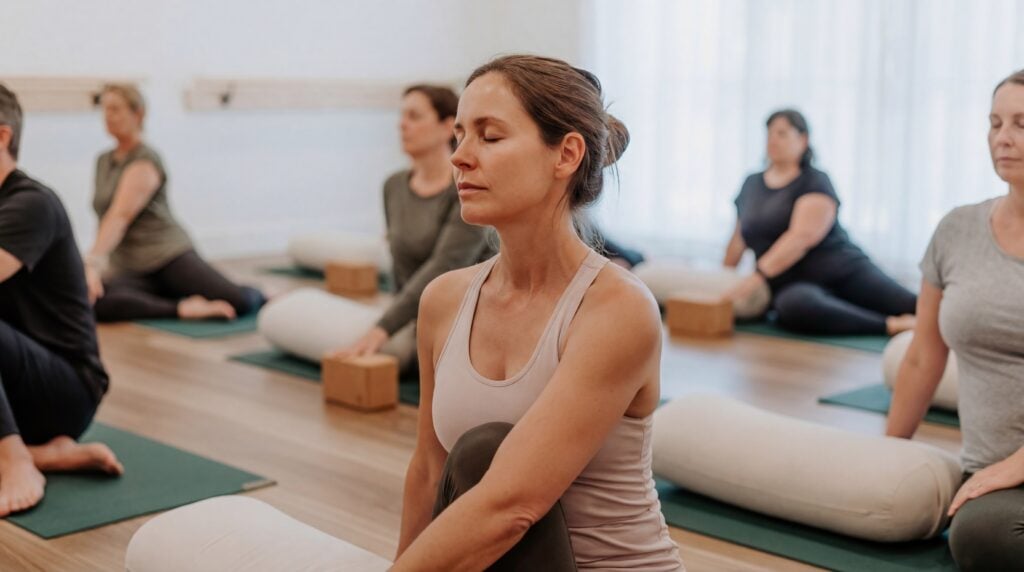
“Yoga or Pilates style workouts can check several boxes at once, including stretching, balance and body weight exercises.”
The reason that matters is that this life stage needs a few things happening simultaneously:
Resistance to preserve muscle and bone.
Controlled movement that doesn’t spike cortisol further.
Flexibility and balance work for joints.
And something that actually supports sleep and mood.
Most exercise does one or two of those.
A 2024 meta-analysis across 11 randomised controlled trials found that mind-body exercise – Pilates, yoga, tai chi – improved bone mineral density, sleep quality, anxiety, depression, and fatigue in perimenopausal and postmenopausal women. A separate trial last year looking specifically at Pilates found measurable improvements in menopausal symptom scores compared to the control group.
I’m writing it because I think the women who need this information most often get it too late – after the symptoms have been dismissed as anxiety, or overwork, or just getting older, when there was actually a more useful explanation available the whole time.
We have members in their 50s and 60s who came to us specifically because high-intensity exercise had started making them feel worse, not better. They weren’t unfit. They were just doing the wrong thing for where they were. Most of them noticed a difference within a few weeks.
If something has felt off for a while and you haven’t been able to put your finger on it, it might be worth looking into. Start with Dr. Haver’s Huberman Lab episode if you’re curious – it’s a couple of hours but worth it.
See you in class,
Mel